How Product Managers Prioritize Complex Feature Requests: 6 Fundamental Principles for Success
How do you prioritize complex feature requests without losing sight of your product’s core vision?
As a product manager, you often face uncertainty when evaluating feature requests that require significant engineering effort. Feature prioritization for product managers can be daunting, especially when simpler implementations seem easier to tackle in your product roadmap planning.
In my experience working with product managers, I’ve seen how structured frameworks and data-driven insights can transform your prioritization process. Effective feature prioritization techniques, such as user story mapping and customer feedback analysis, are crucial for maintaining a balanced product backlog.
In this article, you’ll learn specific strategies and tools to streamline your feature prioritization. We’ll cover approaches like the RICE prioritization framework and stakeholder management in product development, which are essential for ROI-driven feature selection.
Let’s dive into the world of feature prioritization for product managers and explore how cross-functional team collaboration can enhance your decision-making process.

Understanding the Pain of Feature Prioritization
Let’s face it, managing a feature backlog is no small feat. Many product managers struggle with feature prioritization for product managers, balancing numerous requests while maintaining focus on their core vision.
This often leads to burnout and dissatisfaction within teams.
In my experience, people often find that prioritization challenges slow down product roadmap planning and development cycles. The uncertainty can be paralyzing, especially when every request feels urgent.
For instance, several clients report feeling overwhelmed by the sheer volume of feature requests. This constant influx can make it difficult to identify which features truly add value, highlighting the need for effective agile product backlog management.
The impact on team morale is significant. When priorities are unclear, it creates confusion and frustration, ultimately affecting productivity and cross-functional team collaboration in feature prioritization.
Understanding and addressing these challenges is the first step toward effective feature prioritization for product managers. Let’s dive deeper into how you can tackle this problem using techniques like user story mapping and the RICE prioritization framework.

Roadmap for Effective Feature Prioritization
Overcoming this challenge in feature prioritization for product managers requires a few key steps. Here are the main areas to focus on to make progress in product roadmap planning.
- Implement RICE Framework for Feature Scoring: Use RICE scoring to evaluate the impact of each feature, a crucial technique in agile product backlog management.
- Conduct Regular Stakeholder Prioritization Meetings: Hold monthly meetings to ensure alignment, improving stakeholder management in product development.
- Use Data-Driven Insights from User Feedback Tools: Gather and analyze user feedback to inform decisions, enhancing customer feedback analysis.
- Create a Value vs. Effort Matrix for Requests: Assess features based on value and effort required, a key aspect of ROI-driven feature selection.
- Set Clear Criteria for “Must-Have” Features: Define what makes a feature essential, aiding in user story mapping.
- Align Requests with Product Strategy and Vision: Ensure all features support your strategic goals, facilitating cross-functional team collaboration in feature prioritization.
Let’s dive in!
1: Implement RICE framework for feature scoring
Adopting the RICE framework can help product managers objectively evaluate feature requests, enhancing their feature prioritization techniques.
Actionable Steps:
- Calculate RICE scores for each feature in your product roadmap planning.
- Gather data on Reach, Impact, Confidence, and Effort for each feature.
- Use a standardized template for consistency in agile product backlog management.
- Prioritize features by their RICE scores for effective feature prioritization for product managers.
- Rank features in descending order based on their RICE scores.
- Reevaluate and adjust scores quarterly to reflect changing priorities and customer feedback analysis.
Key benefits of using the RICE framework for feature prioritization include:
- Objective evaluation of feature impact
- Improved decision-making based on data for ROI-driven feature selection
- Consistent prioritization across cross-functional team collaboration in feature prioritization
Explanation: Using the RICE prioritization framework provides a clear, data-driven method for prioritizing features. This approach helps ensure that the most impactful features are tackled first in your product roadmap planning.
According to Rapidr, the RICE method helps product managers evaluate which features will provide the most value for customers, aiding in stakeholder management in product development.
Implementing a structured framework like RICE can transform your feature prioritization for product managers, making it more efficient and aligned with your strategic goals, similar to using a value vs effort matrix.

2: Conduct regular stakeholder prioritization meetings
Regular stakeholder prioritization meetings are essential for aligning feature requests with overall product strategy in feature prioritization for product managers.
Actionable Steps:
- Schedule monthly prioritization meetings with key stakeholders for effective stakeholder management in product development.
- Prepare an agenda and share it in advance to ensure productive discussions.
- Implement a collaborative decision-making process for cross-functional team collaboration in feature prioritization.
- Use a voting system for stakeholders to express their preferences, similar to the RICE prioritization framework.
- Document decisions and rationales for transparency and future reference in product roadmap planning.
- Track attendance and participation rates to gauge engagement.
Explanation: Conducting regular stakeholder prioritization meetings ensures that all voices are heard and that feature prioritization aligns with business goals.
This collaborative approach fosters transparency and improves decision-making, crucial for ROI-driven feature selection and agile product backlog management.
According to Canny, balancing between committing to features for high-paying prospects and core product improvements is crucial.
This process helps keep everyone on the same page and makes feature prioritization for product managers more manageable.

3: Use data-driven insights from user feedback tools
Leveraging user feedback tools can significantly enhance your feature prioritization for product managers process.
Actionable Steps:
- Collect user feedback regularly: Use tools like Hotjar and Surveys to gather real-time insights from users. Set up automated feedback collection to ensure continuous data flow for customer feedback analysis.
- Analyze the feedback systematically: Create monthly reports to review user comments, track trends, and identify common pain points for effective product roadmap planning.
- Integrate feedback into prioritization: Develop a feedback loop where user insights directly influence your feature ranking process, enhancing agile product backlog management.
Explanation: Utilizing data-driven insights from user feedback tools ensures that your feature prioritization decisions are grounded in actual user needs and preferences. This approach helps you focus on features that provide the most value to your users, enhancing overall satisfaction and supporting ROI-driven feature selection.
According to Userpilot, incorporating user feedback into the prioritization process can significantly improve product outcomes.
Implementing these steps will help you align your product features with user expectations, driving better engagement and success through effective feature prioritization techniques.

4: Create a value vs. effort matrix for requests
Creating a value vs. effort matrix is essential for feature prioritization for product managers, helping them effectively manage their product roadmap planning.
Actionable Steps:
- Develop a value vs. effort matrix: Evaluate each feature’s potential value against the effort required for implementation. Use a visual tool to map these features, similar to user story mapping.
- Identify quick wins: Focus on features that offer significant value with minimal effort. Prioritize these for faster implementation, enhancing your agile product backlog management.
- Review and adjust regularly: Continuously reassess the matrix to reflect changes in business needs or available resources, incorporating stakeholder management in product development.
Key elements to consider in your value vs. effort matrix:
- Customer impact and satisfaction, based on customer feedback analysis
- Revenue potential or cost savings for ROI-driven feature selection
- Technical complexity and resource requirements, considering cross-functional team collaboration in feature prioritization
Explanation: By using a value vs. effort matrix, you can make more informed decisions, balancing high-value features with realistic implementation efforts.
This approach helps ensure that you are focusing on features that maximize impact without overloading your team.
According to Userpilot, combining different prioritization methods can help balance customer satisfaction and product management goals.
This method streamlines your prioritization process, ensuring alignment with strategic objectives.

5: Set clear criteria for “must-have” features
Setting clear criteria for “must-have” features is essential to maintaining focus on your product’s core vision and strategic goals in feature prioritization for product managers.
Actionable Steps:
- Define specific criteria: Establish criteria based on business objectives, user needs, and market trends. Use a checklist to ensure all necessary elements are considered in product roadmap planning.
- Communicate criteria clearly: Share the criteria with your team during meetings and through documentation. Ensure everyone understands and follows the guidelines, promoting cross-functional team collaboration in feature prioritization.
- Review and update criteria: Regularly assess the criteria to keep them aligned with evolving business goals and user expectations, utilizing customer feedback analysis.
Explanation: Defining and communicating clear criteria for “must-have” features helps prioritize the most impactful requests. This approach ensures alignment with strategic goals and user needs, supporting effective agile product backlog management.
According to Userpilot, incorporating transparent criteria into your prioritization process can enhance decision-making and product outcomes.
This method helps keep your team focused on delivering features that truly matter, driving overall success in feature prioritization for product managers.

6: Align requests with product strategy and vision
Ensuring that feature requests align with your product strategy and vision is crucial for maintaining focus and achieving long-term goals in feature prioritization for product managers.
Actionable Steps:
- Map each request to strategic goals: Evaluate how each feature request aligns with your product’s strategic objectives and vision. Use a strategic alignment score to prioritize features accordingly, incorporating user story mapping techniques.
- Review alignment during quarterly planning sessions: Regularly assess how well the current roadmap supports your overall strategy. Adjust the product roadmap based on these assessments to ensure ongoing alignment and effective agile product backlog management.
Benefits of aligning requests with product strategy:
- Consistent product development direction
- Improved resource allocation through ROI-driven feature selection
- Enhanced long-term product success
Explanation: Aligning feature requests with your product strategy helps maintain a clear focus on long-term goals. This approach ensures that every feature developed contributes meaningfully to your product’s success, utilizing feature prioritization techniques such as the RICE prioritization framework.
According to Rice Business, linking customer value and strategic goals is essential for driving growth.
This method helps keep your team focused and aligned with your strategic objectives, promoting cross-functional team collaboration in feature prioritization.
Partner with Alleo for Streamlined Feature Prioritization
We’ve explored the challenges of feature prioritization for product managers and how solving them can benefit your product’s success. Did you know you can work directly with Alleo to make this journey easier and faster?
Setting up an account with Alleo is simple. Create a personalized plan tailored to your feature prioritization techniques and product roadmap planning needs.
Alleo’s AI coach provides affordable, tailored support, like any human coach. You’ll get full coaching sessions on user story mapping and stakeholder management in product development, plus a free 14-day trial, requiring no credit card.
The coach will follow up on your progress with customer feedback analysis, handle changes in your agile product backlog management, and keep you accountable via text and push notifications. Alleo helps you stay on track and make informed decisions using the RICE prioritization framework and value vs effort matrix.
Ready to get started for free? Let me show you how to improve your cross-functional team collaboration in feature prioritization!
Step 1: Logging in or Creating an Account
To start your feature prioritization journey with Alleo, Log in to your account or create a new one to access the AI coach and personalized support.

Step 2: Choose “Building better habits and routines”
Select “Building better habits and routines” to establish a structured approach for prioritizing features, aligning with your product strategy, and maintaining focus on your core vision – click this goal to start developing consistent practices that will streamline your decision-making process.

Step 3: Select “Career” as Your Focus Area
Choose “Career” as your focus area to align Alleo’s AI coaching with your product management goals, helping you master feature prioritization and advance your professional growth in the tech industry.

Step 4: Starting a Coaching Session
Begin your journey with an intake session to set up your personalized feature prioritization plan, allowing our AI coach to understand your specific needs and tailor guidance for streamlining your decision-making process.

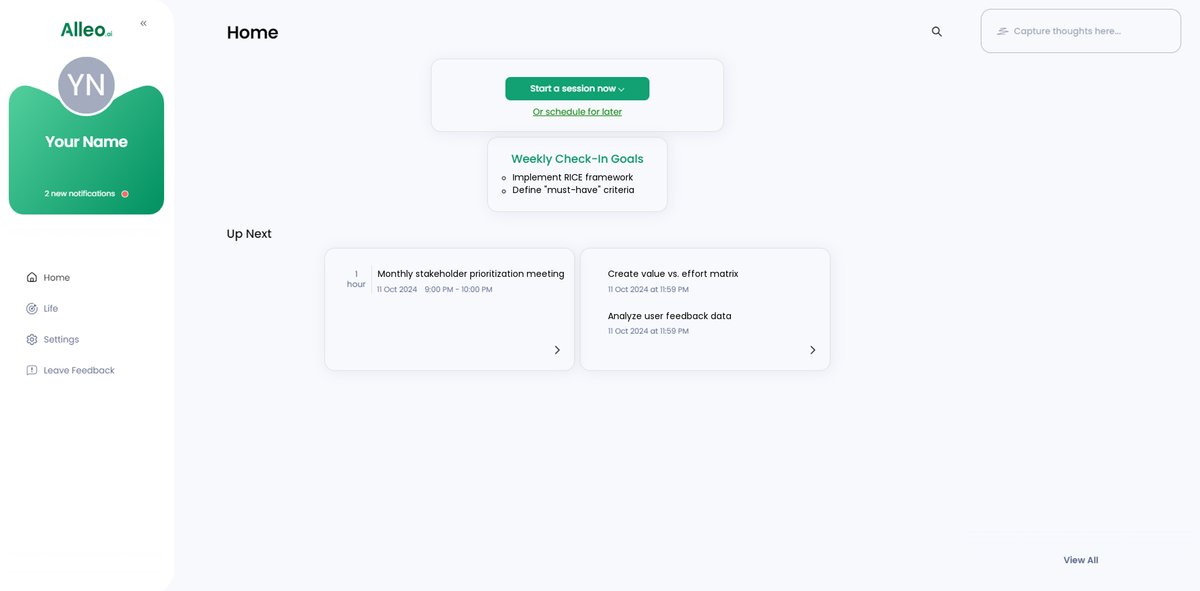
Step 5: Viewing and Managing Goals After the Session
After your coaching session on feature prioritization, check the Alleo app’s home page to view and manage the goals you discussed, helping you stay on track with implementing strategies like the RICE framework and stakeholder meetings.
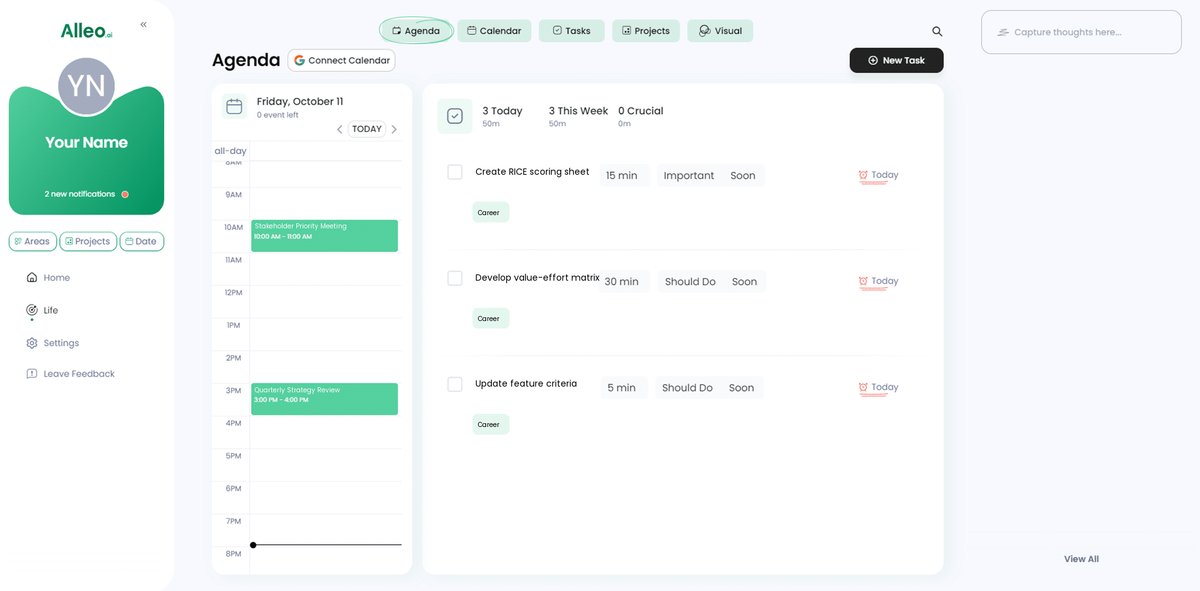
Step 6: Adding events to your calendar or app
Track your feature prioritization progress by adding key milestones and deadlines to the Alleo app’s calendar and task features, ensuring you stay on top of your prioritization goals and maintain alignment with your product strategy.
Bringing It All Together
Feature prioritization for product managers can be daunting, but you now have the tools to tackle this challenge. By implementing structured frameworks like RICE prioritization and holding regular stakeholder management meetings in product development, you can make informed decisions.
Remember to leverage customer feedback analysis and use a value vs. effort matrix to find quick wins. Setting clear criteria for “must-have” features ensures alignment with your product roadmap planning and vision.
Empathy is key in product backlog management. I understand the struggles you face as a product manager.
With Alleo, you can simplify the feature prioritization process and stay focused on ROI-driven feature selection. Try Alleo for free and experience the difference it makes in your user story mapping.
Let’s transform your feature prioritization for product managers together!